Table of Contents
- Introduction
- Built on a Tired Brain
- Circadian Rhythm, Not Willpower
- Sleep Inertia and the Snooze Trap
- Decision Fatigue in the Morning
- Design a Routine That Fits Your Life
- Why Small Works (and How to Automate It)
- Build a Frictionless Runway
- Rethink Caffeine, Breakfast, and Timing
- Right-Size the Rules for ADHD or Sensitive Systems
- A 7-Day Morning Reset
- Mini Case Studies
- Common Myths
- Your Next Best Morning, Step by Step
- The Long Game
- Closing Thought
- Wrap-up + CTA
- The Bottom Line
- References
Key Takeaways
- Sleep and circadian rhythm set your morning ceiling; design with biology, not willpower.
- Keep a simple, minimum viable morning: one anchor habit and one 10-minute task.
- Use if-then plans and a staged environment to remove decisions and friction.
- Expect sleep inertia; plan a 10–15 minute groggy buffer before deep work.
- Consistency beats intensity—align timing, keep the bar low, and repeat.
Introduction
You set the alarm for 5:30. You laid out the leggings, queued up the espresso, bookmarked the journaling prompts. Tomorrow was going to be different. Then the alarm drilled through your skull, and your hand found the snooze like a homing device. Thirty minutes later you were under the covers, doomscrolling headlines about productivity hacks—promising yourself you’d try again Monday.
If this rings uncomfortably true, your morning routine for productivity isn’t failing because you’re lazy. It’s failing because the plan ignores how your brain, your biology, and your actual life work. I’ve blown up enough dawn routines to say this plainly: the problem is design, not character.
Let’s pull apart the myths and rebuild something you can count on—even on the messy days.
Why your morning routine for productivity fails: it’s built on a tired brain
Most lists start with tactics: hydrate, journal, cold plunge. The hard truth? The single best predictor of a strong morning isn’t what you do at 6 a.m.—it’s what you did at 10 p.m. the night before. The CDC still recommends at least 7 hours of sleep, and about 1 in 3 adults in the U.S. falls short. When you wake up underslept, the prefrontal cortex—the part that steers decisions, focus, planning—goes dim. No wonder a willpower-only routine collapses.
“If you try to stack ambitious habits on top of sleep debt, you’re loading a building on wet cement. It looks upright for a minute, then it sinks.”
— Dr. Sarah Chen, Licensed Clinical Psychologist
I think that’s the whole game most weeks.
Why it fails:
- Sleep debt blunts attention and working memory—the exact capacities your morning routine for productivity demands.
- You can’t out-hustle physiology. You either work with it—or pay for fighting it.
How to fix it:
- Anchor the night. Protect a non-negotiable window that puts you in bed long enough to net 7–9 hours.
- Fix your wake-up time within a 30-minute band—even on weekends—to steady your circadian rhythm.
- Dim screens 1–2 hours before bed to avoid evening blue light suppressing melatonin.
Circadian rhythm, not willpower, sets your morning ceiling
Some mornings your mind is butter-soft; others, it’s sharp like new glass. That swing isn’t random—it’s circadian rhythm, the roughly 24-hour clock regulating sleepiness, alertness, body temperature, hormones. If your world forces a night owl into a pre-dawn wake, your morning routine for productivity will feel like wading through molasses.
“A 5 a.m. routine can be magical—for larks. For owls, it’s jet lag every day. Alignment beats ambition.”
— Dr. Javier Morales, Chronobiologist and Sleep Clinic Director
He’s right; the calendar wins.
Why it fails:
- Misaligned timing creates “social jet lag,” draining mood, motivation, and cognitive performance.
- Forcing habits at the wrong circadian phase turns a routine into punishment.
How to fix it:
- If you’re an owl, nudge earlier gently: shift bedtime and wake time by 15 minutes every few days, pair with morning light, keep evenings dim. Patience here is policy.
- Use morning light like a start button. Open curtains immediately; if it’s still dark, consider a 10,000-lux light box after speaking with your clinician.
Sleep inertia, the snooze button, and why “just get up” doesn’t stick
Even with enough sleep, the first 15–60 minutes after waking can be foggy. That’s sleep inertia—the brain switching from sleep to full alertness. Normal, annoying, and not a moral referendum. If your morning routine for productivity requires instant clarity, inertia will win.
“People assume grogginess means the routine isn’t for them. No—grogginess is biology. Design for the ramp, not the launch.”
— Dr. Sarah Chen, Licensed Clinical Psychologist
Why it fails:
- You demand deep focus in the first five minutes upright.
- The snooze button fragments sleep and often prolongs inertia.
How to fix it:
- Build a 10–15 minute “groggy buffer” of low-cognitive steps: open blinds, rinse face, drink water, step outside.
- Park the alarm across the room. Pair it with immediate bright light—both reduce inertia.
- Time caffeine strategically; using it once you’re upright helps you associate wakefulness with movement.
Decision fatigue: the hidden tax on ambitious mornings
If your checklist includes warm lemon water, 20 minutes of breathwork, three pages of journaling, a 45-minute workout, and a protein-packed breakfast before sunrise, you’ve engineered dozens of micro-decisions before 7 a.m. Decision fatigue hits early when rituals are complex.
“Complexity is the enemy of mornings. Two repeatable actions beat ten aspirational ones every time.”
— Marcus Patel, Productivity Coach
Why it fails:
- Too many options stall action and spike avoidance.
- You’re asking a sleepy brain to plan, choose, and execute—then punishing it when it balks.
How to fix it:
- Default everything. Same alarm sound, same first song, same mug, same 7-minute mobility flow, same breakfast Monday–Friday.
- Use implementation intentions—if-then rules that pre-decide your next step and automate behavior.
Copy-paste isn’t a strategy: your life needs its own blueprint
You saw a founder’s 4 a.m. routine on TikTok and tried to graft it onto a job with a 9 a.m. standup, a dog that needs walking, and roommates who fry onions at midnight. No wonder it unraveled. Your morning routine for productivity must fit your constraints, not an influencer’s montage.
When Maya, 28, went through her divorce in 2021, she tried to keep up a 10-step sunrise ritual. It collapsed under grief, paperwork, and late-night calls with her lawyer. She rebuilt around a single anchor: at 7 a.m., she opened the blinds, brewed tea, and stood on the balcony for five deep breaths. That foothold led to light stretching. Two months later, she felt “human before emails” again. The power wasn’t the tea—it was the fit.
Why it fails:
- Aspirational routines ignore real constraints—time, kids, shift work, grief.
- All-or-nothing thinking (“If I can’t do the whole thing, I’ve failed”) torpedoes consistency.
How to fix it:
- Choose a minimum viable morning: one 2–5 minute anchor doable at a 2/10 energy level.
- Treat everything else as “bonus.” Momentum loves low bars more than pride does.
The science behind why small works—and how to make it automatic
Our brains love clarity. Vague goals like “be productive” flounder; crisp cues and simple actions stick. That’s why implementation intentions work so well in a morning routine for productivity. They turn a choice into a trigger.
Why it works:
- If-then plans lower cognitive load and make action reflexive.
- Repeating the same steps in the same context builds procedural memory; habits, over time, run on less conscious effort.
How to do it:
- Write three specific if-then rules for your morning:
- If I turn off the alarm, then I open the blinds.
- If I open the blinds, then I drink a full glass of water.
- If I finish the water, then I open my laptop and start a 10-minute focus block.
- Put the cues where your morning happens. Water glass on the nightstand, blinds cord within reach, laptop on the table with one tab open.
Build a frictionless runway: environment, light, and movement
If your sneakers are in the closet, your headphones uncharged, and your to-do list buried in notes, you’re making a hard thing harder. Friction kills mornings. Environment, in my view, beats motivation nine days out of ten.
Why it works:
- Design trumps mood. Laying out gear, preloading playlists, and staging your workspace lowers the activation energy required to start.
- Morning light anchors circadian rhythm; paired with gentle movement, it speeds the fade of sleep inertia.
How to do it:
- Stage three items the night before: clothes, a filled water bottle, and your task cue (a post-it with your first 10-minute task).
- Step into light within five minutes of waking. Balcony, stoop, window—use what you have.
- Move for 5–10 minutes. It needn’t be a workout; think mobility, a hallway walk, or one song of movement.
Rethink caffeine, breakfast, and “ideal” timing
Caffeine isn’t the enemy—it’s a tool. Its effects can linger for hours, so front-load it enough to avoid disrupting sleep later. If you’re prone to jitters, pair coffee with food. As for breakfast, there’s no universal rule. What matters is stability: pick a pattern that keeps your energy steady rather than spiking and crashing.
Calm beats clever.
If you have ADHD or a sensitive nervous system, right-size the rules
Rigid, perfectionist mornings often backfire for ADHD brains. Externalize the structure, not the pressure. Think alarms, visual timers, and checklists on your wall—not a harsh running commentary in your head.
Why it works:
- External cues reduce working-memory demands when your brain is least resourced.
- Visible progress (checkboxes, timers) triggers dopamine and motivation more reliably than abstract goals.
How to do it:
- Use a single, step-by-step card with three moves: Wake, Light, Start. Check them off. That’s a win.
- Pair focus with body cues: chew gum, hold a warm mug, or sit on a balance cushion for sensory input during your first 10-minute block.
A 7-day reset to rescue your morning routine for productivity
This isn’t a bootcamp. It’s a gentle reset that respects biology.
Day 0 (Tonight): Choose a fixed wake time you can keep 7 days. Set your environment: lay out clothes, fill a water bottle, place a note with your first 10-minute task. Dim screens 90 minutes before bed; keep your room cool and dark.
Day 1–2: Do the minimum viable morning only.
- If alarm off, then blinds open.
- If blinds open, then drink water.
- If water done, then 10-minute light movement by a window.
No journaling. No inbox. Success criterion: check the three boxes.
Day 3–4: Add a single focus block.
- After movement, sit for a 10-minute “starter task” you prepared the night before. Use a timer. Stop when it dings. Keep caffeine after movement.
Day 5–6: Personalize the plus-one.
- Choose one optional element that feeds you: a 5-minute gratitude note, a 10-minute walk, or prepping a protein-rich breakfast. Keep it optional. Extras should feel like gifts, not tests.
Day 7: Review and lock the floor.
- What felt heavy? Remove it.
- What felt like wind in your sails? Keep it.
- Write your three if-then rules for the week ahead, post them where you’ll see them.
Two mini case studies: different lives, same principles
- Greg, 35, product manager, night owl. Tried a 5 a.m. gym habit for months—failed half the time. He shifted to a 7 a.m. wake, used a sunrise lamp, and set a 7-minute kettlebell flow at home. Gym moved to lunch twice a week. Result: 5 straight weeks of consistent mornings and on-time sleep, fewer crashes in afternoon standups. Timing beat toughness.
- Nia, 26, barista and graphic designer with rotating shifts. Traditional routines were impossible. She built a “modular” morning routine for productivity: Wake, Light, Water on every shift; on late shifts, she added 10 minutes of portfolio work; on earlies, she just stretched. The continuity of the core kept her grounded despite chaos.
Common myths that quietly sabotage you
- “If it’s not hard, it’s not working.” Your best routine feels almost boring. That’s a feature.
- “I should journal/work out/meditate every morning.” Do what reliably improves your day when repeated—even 7 minutes counts.
- “Snoozing ruins everything.” Snoozing isn’t moral failure; it’s a sign your sleep window or alarm strategy needs adjusting. Fix the system, not your character.
Your next best morning, step by step
- Respect the ramp. Sleep inertia is real. Plan low-brain actions first.
- Align with your clock. Use morning light and consistent wake times to steady your circadian rhythm.
- Shrink the checklist. One anchor habit, then one 10-minute task beats a bloated routine.
- Pre-decide with implementation intentions. Swap “I’ll try” for “If X, then Y.”
- Stage the scene. Set up your environment so the first steps are obvious and frictionless.
- Track only the floor. Count the minimum, not the bonus.
If you’ve been blaming yourself, breathe. You were trying to brute-force a plan that ignored sleep, rhythm, friction, and attention. The moment you design your morning routine for productivity around how your brain and body actually work, things start to click. We’ve all felt the tug of “revenge bedtime procrastination.” Systems—quiet, repeatable ones—are the antidote.
The long game: choose consistency over intensity
“Circadian systems and habits both love regularity. Small, repeatable beats heroic and rare.”
— Dr. Javier Morales, Chronobiologist and Sleep Clinic Director
Your job isn’t to build a cinematic sunrise montage. It’s to build a pattern that survives real life: late dinners, sick kids, busy seasons, low-motivation Mondays. Let your morning routine for productivity be a launchpad, not a litmus test of worth. Keep the bar low, the light bright, and the next step obvious. It’s not glamorous—but it’s durable.
Closing thought: The right routine starts tonight
Tonight, set up one glass of water and one sticky note. Tomorrow, open the blinds and drink the water. Then do ten minutes on one task that matters. Your morning routine for productivity doesn’t need to be longer. It needs to be yours. And once it’s yours, it starts working.
Wrap-up + CTA
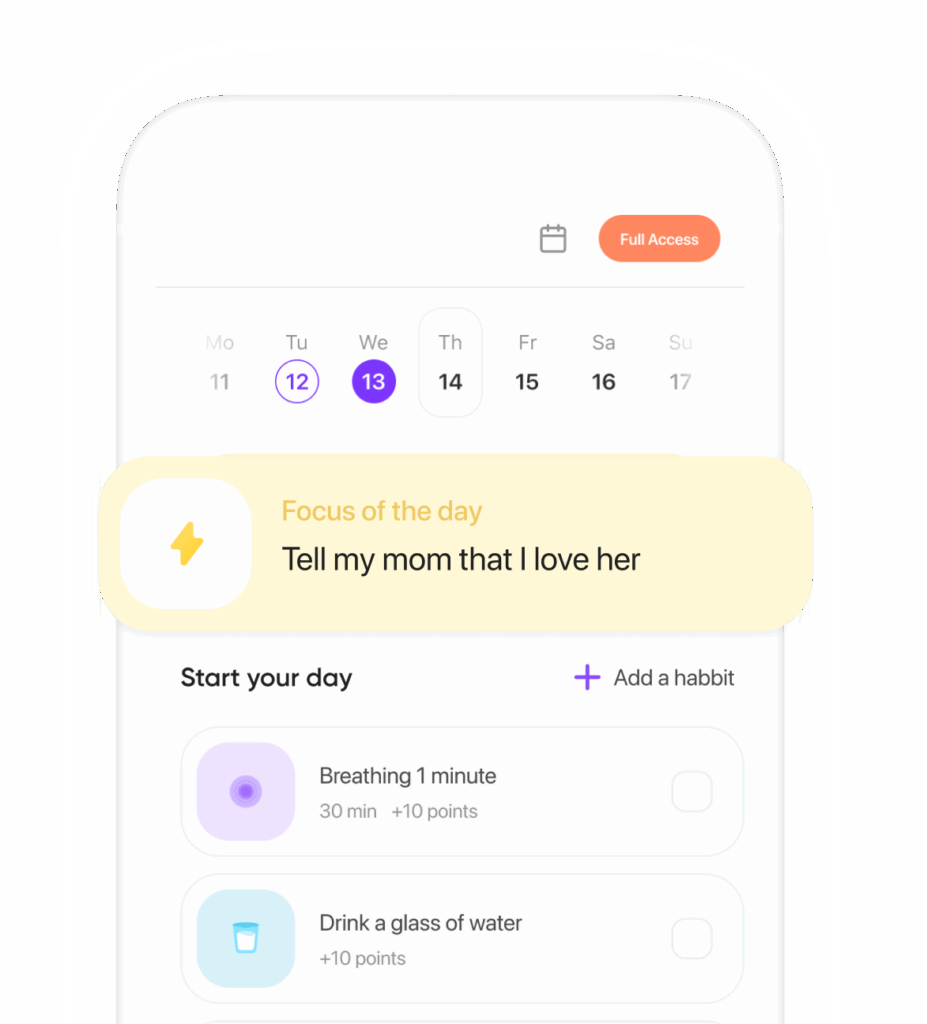
Morning success isn’t magic. It’s biology-aware, low-friction design: solid sleep, gentle light, tiny anchors, and clear if-then moves. Build a morning routine for productivity that fits your life, not the internet’s. Want help turning this into daily action? Try Sunrise – ADHD Coach for habit tracking, focus timers, and AI-powered daily planning built for ADHD minds. Download: https://apps.apple.com/app/adhd-coach-planner-sunrise/id1542353302
The Bottom Line
Design your mornings around sleep, light, and simplicity. Lock a consistent wake time, plan a short groggy buffer, default your first 1–2 actions, and use if-then rules to remove decisions. Keep the floor low and repeat. Small, aligned steps—done daily—beat heroic efforts you can’t sustain.
References
- Centers for Disease Control and Prevention (CDC) — How Much Sleep Do I Need?
- Centers for Disease Control and Prevention (CDC) — 1 in 3 adults don’t get enough sleep
- National Institute of General Medical Sciences (NIH) — Circadian Rhythms
- Harvard Health Publishing — Blue light has a dark side
- Mayo Clinic — Sleep tips: 6 steps to better sleep
- MedlinePlus (NIH) — Caffeine
- World Health Organization (WHO) — Physical activity