Table of Contents
- Introduction
- Why Identity Hijacks Your Habits
- A Note on Dependence and Medical Care
- How to Break Bad Habits with Identity Shifts: The Core Idea
- How to Do It: Turn Identity into Evidence
- How to Break Bad Habits: A Step-by-Step Field Guide
- Two Mini Case Studies
- Troubleshooting Common Snags
- Science Corner: What’s Really Changing?
- Expert Perspectives You Can Use Tonight
- A 7-Day Identity Quickstart
- An Honest Word About “Bad” Habits
- Your Next Right Step
- The Bottom Line
- References
Key Takeaways
- Shift from “What should I do?” to “Who am I becoming?” to make better habits feel natural.
- Cast daily “votes” for your identity with tiny, two-minute proofs and clear cues.
- Use friction to disrupt old loops and if-then plans to follow through under pressure.
- Leverage community and environment—identity spreads through proximity.
- Sleep and movement are anchor habits that amplify self-control and mood.
Introduction
On a rain-fogged Tuesday, you promise yourself you’ll stop doomscrolling before bed. You mean it. Midnight lands; your thumb keeps flicking. The “new you” doesn’t show. If this feels like Groundhog Day, there’s another route—quieter, oddly sturdier: change the way you name yourself. When you redefine who you are, your choices take orders from a different editor.
You might be thinking, I’ve tried “positive thinking.” This isn’t that. Identity work changes the question from “What should I do?” to “Who am I becoming?” Behaviors that needed grit begin to feel obvious—even automatic—because they align with a story you trust. The work is to turn that story into something you can’t ignore. Proof you see, daily. I’m convinced this is the most humane way to change.
Why Identity Hijacks Your Habits
-
The brain loves shortcuts. Habits automate the routine so your mind can spend its energy elsewhere. NIH News in Health describes this as a cue–routine–reward loop that deepens with repetition, making a behavior easier to start without much thought. In plainer terms: practice writes code in your nervous system.
-
Rewards train attention. Anticipation and payoff release dopamine in the brain’s reward system, which reinforces whatever came just before it, as the National Institute on Drug Abuse has long outlined. If your quiet self-image says, “I’m a night owl who scrolls to relax,” tiny dopamine surges keep that loop humming. It isn’t moral failure. It’s learning.
-
Self-concept sets guardrails. In psychology, identity is your sense of who you are—your beliefs, roles, values. When your actions clash with that story, tension rises. Shift the story, and the pressure tilts in a different direction. In my experience, those guardrails do more than rules ever could.
“Most people try to outmuscle habits with motivation. It’s exhausting. Identity flips the script—now you’re not forcing yourself to behave; you’re acting in character.”
— Dr. Lina Patel, Clinical Psychologist (Behavior Change)
A Note on Dependence and Medical Care
If your “bad habit” involves dependence—alcohol, nicotine, gambling—identity work can help, but it’s not a replacement for medical or therapeutic care. Evidence-based treatments such as cognitive behavioral therapy and, when appropriate, medication, may be essential. That’s not a moral comment. It’s biology.
How to Break Bad Habits with Identity Shifts: The Core Idea
Think of identity as a vote tally. Every tiny action is a ballot for the kind of person you are. You don’t need all the votes to win—just a durable majority, day after day.
- Old approach: Outcome-based. “I want to stop hitting snooze.” Feels like self-denial. It often backfires.
- Identity approach: “I’m the kind of person who starts the day on purpose.” Feels like self-expression. It opens doors.
Why it works:
- Cognitive alignment reduces friction. Behaving “on brand” is less taxing than constantly overriding impulses. The American Psychological Association’s definitions around habit make this clear. My take: when your identity fits the action, you stop arguing with yourself.
- Dopamine starts to predict identity-consistent acts. When “this is who I am” carries its own reward—pride, integrity—your brain begins to anticipate that feeling, which makes the action more appealing. Back in 2021, several labs studying motivation emphasized that prediction is half the reward.
How to Do It: Turn Identity into Evidence
When I reached behavioral neuroscientist Dr. Marcus Lee, he didn’t mince words:
“Identity is earned. You don’t affirm it—you accumulate it. The smallest repeatable action that proves your story is your master key.”
— Dr. Marcus Lee, Behavioral Neuroscientist
Here’s a field-tested sequence you can start today.
-
1) Choose a one-line identity that solves your problem indirectly
- Not “I’m not a procrastinator.” Instead: “I’m a starter who touches hard tasks in two minutes.”
- Not “I don’t eat late.” Try: “I’m a mindful eater who closes the kitchen after dinner.”
Why this works: Positive identities pull you toward a behavior; negative ones trap your attention on what you’re trying to avoid. In my view, approach beats avoidance nine times out of ten.
-
2) Stack “proof” with two-minute actions
- Repetition cements loops, as NIH News in Health notes. Begin micro: one push-up. One paragraph. One drawer.
- Your daily question: What’s the smallest move that makes this identity true right now?
Case in point: When Maya, 28, waded through a breakup, late-night snacking surged. Her new identity—“I’m someone who ends my night with tea and a page of journaling”—wasn’t about food; it was about closure. For two weeks, she brewed tea at 9:30 p.m. The cue shifted. By 9:45, the kitchen light clicked off—quiet proof.
Pro Tip: Make two-minute actions “unskippable” by pairing them with an existing routine (after brushing teeth, brew tea; after opening laptop, write one sentence). -
3) Design cues and add friction to the old loop
- Put the new cue in your path. Drape gym clothes on the doorknob. Leave your writing doc open. Set a 9:30 p.m. tea timer.
- Make the old behavior harder: move apps off your home screen, stash snacks up high, park the TV remote in another room.
Why this works: Habits are exquisitely context-sensitive. Alter cues and effort costs and you change the default, without leaning on motivation. I’ve rarely seen this fail when the friction is real.
Pro Tip: Change one object’s location per week (phone, snacks, remote). Small shifts compound into big defaults. -
4) Script “if-then” decisions before you need them
- If I feel the urge to scroll in bed, then I’ll plug my phone in the kitchen and read two pages on the couch.
- If I miss my morning run, then I’ll walk 10 minutes at lunch.
Why this works: “Implementation intentions”—preloaded cue–action plans—boost follow-through. The APA has cataloged this for years. It’s less glamorous than inspiration, far more effective.
-
5) Borrow identity from your environment
- Join a space where your identity is the norm: a running club, a coworking sprint, a lights-out-by-10:30 group chat.
“Identity spreads through proximity. Make ‘people like me do things like this’ visible.”
— Dr. Lina Patel, Clinical Psychologist (Behavior Change)
My bias: community beats willpower.
-
6) Track wins you can’t argue with
- Keep a “Proof Log.” One line per day: date + action that matched your identity. No streaks to break—just pages to fill.
- Celebrate privately and specifically: “I’m proud I started the draft, even for two minutes.” It sounds small. It isn’t.
-
7) Reframe slips as system feedback
- A slip is a signal. Ask: What cue was present? What friction was missing? What feeling was I trying to change fast?
- Update one element—time, place, duration, prompt—then test again. Iteration beats judgment every time.
How to Break Bad Habits: A Step-by-Step Field Guide
Phase 1: Choose and clarify (Day 1)
- Write your one-sentence identity.
- Identify one cue and one two-minute action.
- Remove one convenience that props up the old habit.
Phase 2: Prove it tiny (Days 2–7)
- Run your two-minute action at the same cue daily.
- Log evidence in your Proof Log.
- Use one if-then plan for your strongest trigger.
Phase 3: Expand and embed (Weeks 2–4)
- Scale slowly: 2 minutes to 5, 5 to 10.
- Add environment allies: group, buddy, or a public commitment.
- Build one “identity anchor” habit that boosts everything: sleep or movement.
Why anchors matter: Sleep and movement improve self-regulation and mood, which lightens the lift on every other habit. The CDC recommends 7+ hours for adults and ties short sleep to impaired performance and higher health risks. The WHO recommends 150–300 minutes of moderate activity weekly for adults—benefits that include mental health and reduced chronic disease risk. Exercise also buffers stress, which is often the hidden driver of the very loops you want to break. If I could underline one lever, it’s this.
Two Mini Case Studies
-
Jordan, 33, could scroll TikTok for hours after work. He picked the identity: “I’m a reader who unwinds with a chapter.” His if-then: If I sit on the couch after dinner, then I place my phone on the bookshelf and open my book for 10 minutes. He joined a Saturday book club—identity by osmosis. Four weeks later, his Proof Log held 23 entries. He still scrolled some nights, but the majority identity had shifted: reader first, scroller sometimes. That’s a real win.
-
Kat, 25, skipped breakfast and binged sweets midafternoon. Her line: “I’m a nourisher who builds meals before cravings hit.” She prepped a yogurt-and-fruit cup nightly. As NIH points out, repeated, accessible behaviors get automatic. For Kat, “nourisher” wasn’t about restriction; it was reliability. Fewer crashes; steadier energy.
Troubleshooting Common Snags
-
“I don’t believe the identity yet.”
Start where you can stand it: “I’m becoming the kind of person who…” Then gather proof. Confidence grows from doing, not declaring. I think we forget that belief often trails behavior. -
“I relapse under stress.”
Expect it. Stress resurrects old loops because the brain seeks fast relief. Put an if-then plan on your calendar for high-risk days. Even a five-minute walk can reset your nervous system and protect the identity you’re building. -
“My environment works against me.”
You can’t willpower-proof a kitchen full of triggers or a nightstand lit by notifications. Shift one object’s location per week: snacks, remote, phone, alcohol, apps. Small moves, big cumulative effect. -
“This feels slow.”
It is—and that’s the point. Habits are compounding interest for the self. Slow is smooth; smooth becomes fast. I’d take durable over dramatic, every time.
Science Corner: What’s Really Changing?
- Habit loops: You’re not only disrupting a cue—you’re pairing a different routine with the same cue and a new reward (pride, progress), training the brain to expect a different dopamine payoff. The NIDA framework on reward is helpful here.
- Self-efficacy: Each success raises your belief that you can act effectively—predicting persistence, according to APA’s work on the construct. One pebble at a time, you build a path.
- Narrative coherence: People seek to behave in ways that match their identity stories. When your story is simple and repeatable, it narrows choices in your favor. This is, in my view, the underrated engine of change.
Expert Perspectives You Can Use Tonight
“Make your identity visible. Put it on your lock screen. When you see it at the moment of choice, you vote for it more often.”
— Dr. Lina Patel, Clinical Psychologist (Behavior Change)
“Shrink the habit until it’s unskippable. It’s the daily casting of a vote that tips the brain’s scales.”
— Dr. Marcus Lee, Behavioral Neuroscientist
“Social identities stick. One weekly meetup with people who ‘do what you do’ often beats five solo hacks.”
— Elena Ruiz, MPH, Health Behavior Specialist
A 7-Day Identity Quickstart
- Day 1: Write your one-line identity. Pick a two-minute action and cue. Remove one old-habit convenience.
- Day 2: Do the action. Log your proof. Note how it felt before and after.
- Day 3: Add an if-then script for your toughest trigger.
- Day 4: Tell one person. Ask for a one-line check-in text at your cue.
- Day 5: Move the main trigger object (phone, snacks, remote) out of reach.
- Day 6: Repeat your action. Re-read your Proof Log.
- Day 7: Add one minute or one rep. Keep the identity line where you’ll see it.
An Honest Word About “Bad” Habits
Not all habits are equal. Some once helped you cope; others signal deeper stress, trauma, or dependence. If you’re facing substance use or compulsive behaviors that feel out of control, pair identity work with professional support. Start by understanding how reward systems reinforce compulsion, and consider evidence-based therapies. You’re not “weak.” Your brain is doing what it was trained to do—and it can be retrained with help. The Guardian reported in 2021 that doomscrolling itself became a coping mechanism during lockdowns; naming the pattern was step one. Getting help is step two.
Your Next Right Step
If you’ve white-knuckled change and burned out, here’s your permission to trade force for identity. Choose one line. Prove it tiny. Collect evidence you can’t unsee. That’s how to break bad habits with identity shifts—not by waiting for a new personality to arrive, but by assembling it one honest vote at a time. It’s slower than you want, and faster than you think.
Summary: Identity shifts turn “shoulds” into “that’s what I do” by aligning habits with a clear self-story. Use tiny proofs, cue design, if-then plans, and social identity to make change stick. Sleep and movement amplify self-control, while a Proof Log builds belief. Start small, act daily, and let identity do the heavy lifting.
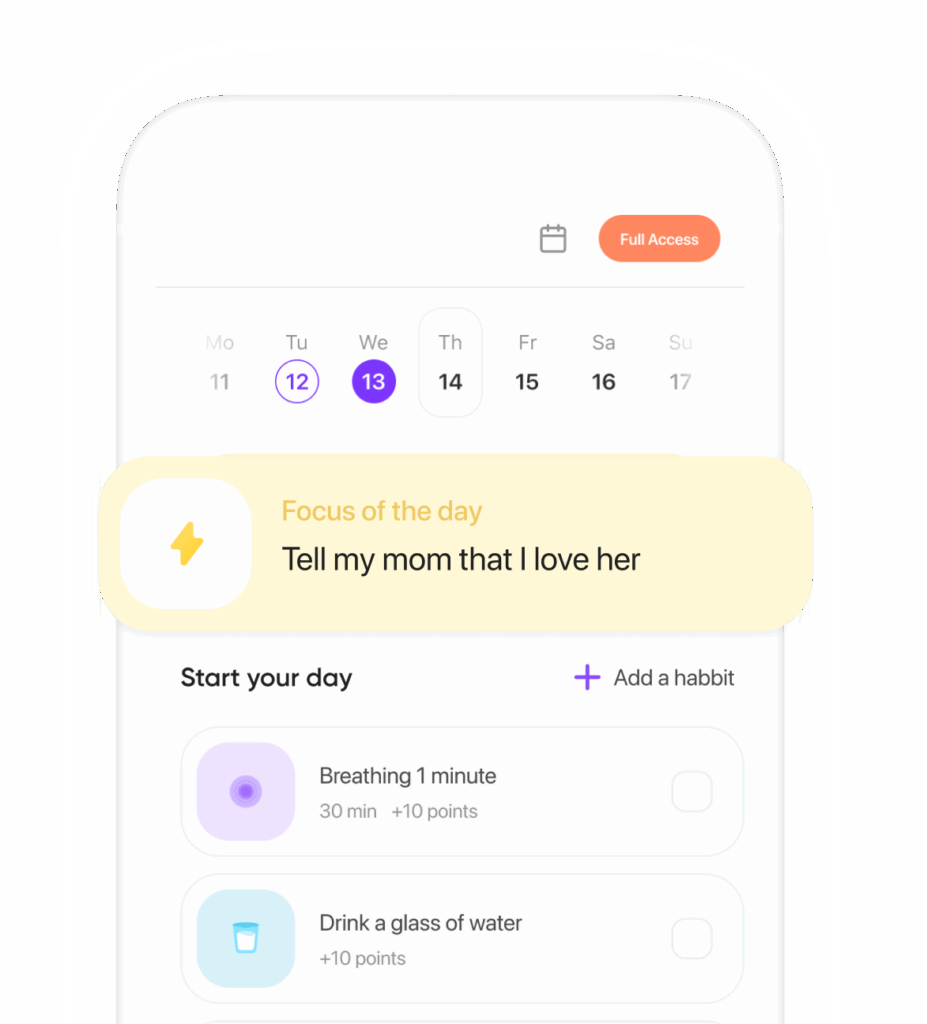
Ready for structure and focus? Try Sunrise – ADHD Coach for habit tracking, focus timers, and AI-guided daily planning built for ADHD minds: https://apps.apple.com/app/adhd-coach-planner-sunrise/id1542353302
Image alt text: “how to break bad habits with identity shifts — morning routine starter kit on a bedside table”
The Bottom Line
Change sticks when it matches your story. Pick a simple identity, prove it with tiny, repeatable actions, and shape your environment so the “right” choice becomes the easy one. Let identity—not willpower—do the heavy lifting.
References
- NIH News in Health
- National Institute on Drug Abuse: The Reward System
- APA Dictionary of Psychology (Identity)
- APA Dictionary of Psychology (Habit)
- APA Dictionary of Psychology (Implementation intention)
- APA Dictionary of Psychology (Self-efficacy)
- Centers for Disease Control and Prevention (Sleep)
- World Health Organization (Physical activity)
- Mayo Clinic (Exercise and stress)